
Last updated: April 2, 2026
The AI SEO Automation Playbook: How SMBs Scale Google Rankings Without a Full-Time Team
Zaid Hadi - CEO & Founder of repli
The AI SEO Automation Playbook: How SMBs Scale Google Rankings Without a Full-Time Team
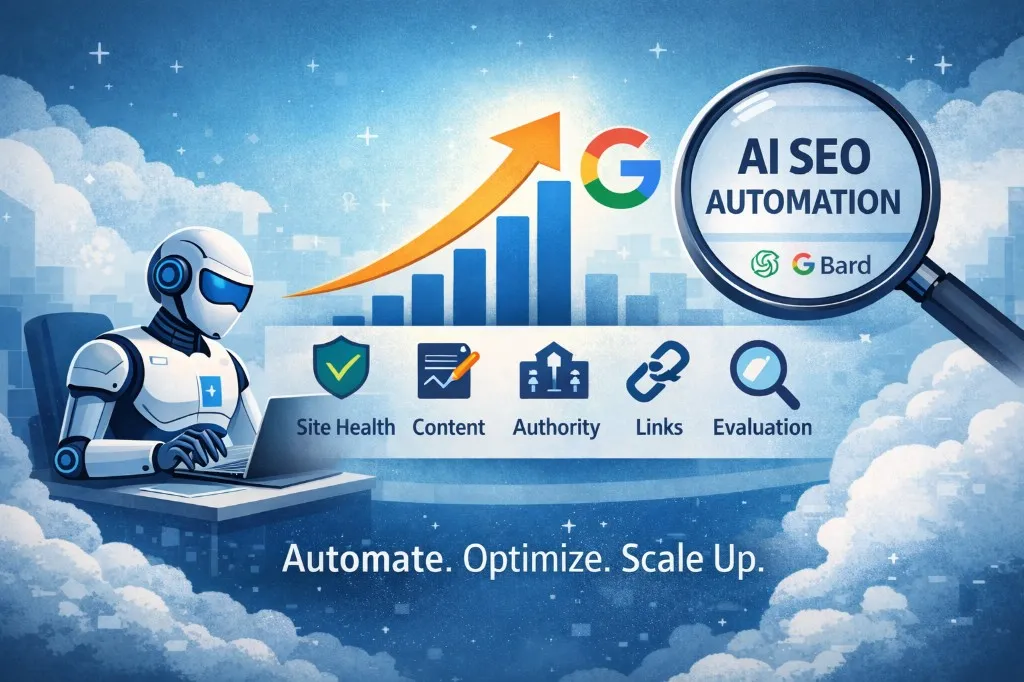
BrightEdge research establishes that organic search alone drives 53% of all trackable website traffic, making it the single largest channel for online discovery ahead of paid search, social, and direct traffic combined. Yet HubSpot data shows 65% of SMBs cite "generating traffic and leads" as their top marketing challenge. The disconnect is clear: search still dominates how people find businesses online, but most small teams lack the bandwidth to compete. This pillar page maps the full landscape of AI-powered SEO automation, covering what it is, which tasks it replaces, how it differs from traditional SEO tooling, and a concrete framework for deciding which parts of your SEO stack to automate first. Each section connects to deeper cluster articles on automated SEO basics, Google ranking automation, SaaS SEO fundamentals, and scaling with AI.
Table of Contents
- Why Traditional SEO Breaks Down for Small Teams
- AI SEO Overview: What Automation Actually Replaces
- The SCALE Framework: Five Layers of SEO Automation
- Manual SEO vs Automated SEO: A Side-by-Side Decision Table
- SEO Automation for SMBs vs SaaS: When the Playbook Differs
- Step-by-Step: How to Implement Google Ranking Automation From Zero
- Readiness Checklist: Is Your Site Ready for AI SEO Scaling
- Summary
- Frequently Asked Questions
Key Takeaways
| Point | Details |
|---|---|
| Most SMBs under-publish by 80%+ | Consistent daily or weekly publishing is the single largest driver of compounding organic traffic, yet most small businesses publish fewer than once a week. |
| AI automates five distinct SEO layers | The SCALE Framework covers Site health, Content creation, Authority building, Link optimization, and Evaluation, and each layer can run on autopilot with the right tooling. |
| Automation does not mean zero oversight | Google does not penalize AI-generated content as a category; it penalizes low-quality content that lacks editorial review, which means any automated SEO workflow must include human approval steps to remain compliant with Google's quality guidelines. |
| SMB and SaaS SEO strategies diverge on authority signals | SaaS companies need product-led content and integration pages, while local SMBs benefit more from geo-targeted and service-specific automation. |
| Early results appear in 4-8 weeks on long-tail keywords | Automated daily publishing compounds domain authority faster than sporadic manual efforts, with AI search citations often appearing within 2-6 weeks. |
| Agencies cost 10-30x more with slower output | A typical SEO agency charges between $3,000 and $10,000 per month while producing 2–4 articles per week, whereas AI-automated SEO platforms deliver 5–7 or more articles per week with built-in GEO optimization at a cost of $100–$500 per month. |
Why Traditional SEO Breaks Down for Small Teams
Traditional SEO breaks down for small teams because it demands consistent time across keyword research, content creation, technical audits, and link building, resources most SMBs simply do not have. A founder spending 10+ hours per week on SEO tasks that still underperform is not an edge case; it is the norm.
The gap between knowing SEO matters and actually executing it is where most businesses stall. SERP data confirms the frustration: titles like "spent $17k+ and still..." reflect real outcomes when manual effort cannot keep pace with what search engines reward.
The five SEO tasks that consume the most SMB time:
- Content writing and editing
- Keyword research and topic planning
- Technical site fixes (speed, crawl errors, broken links)
- Backlink outreach and relationship building
- Performance reporting and rank tracking
Now add a new complexity layer. AI-powered answers in ChatGPT, Perplexity, and Google AI Overviews are reshaping how users find information. According to SparkToro's analysis of SimilarWeb clickstream data, 60% of Google searches end without a click to any website, meaning businesses that rely solely on traditional blue-link rankings are invisible to the majority of searchers. If your content is not structured for both traditional rankings and AI citation, you are losing visibility on two fronts simultaneously. The fundamentals of AI SEO and automated content exist precisely to close this gap. A deeper dive into automated SEO basics covers the specific tools and workflows that replace these manual bottlenecks.
AI SEO Overview: What Automation Actually Replaces
AI SEO automation replaces the manual, repetitive layers of search optimization, including keyword research, content drafting, publishing schedules, technical auditing, and backlink prospecting, while leaving strategic decisions and editorial approval to humans.
Five specific tasks you can automate today:
- Keyword discovery: AI platforms analyze real search demand and competitor gaps to surface high-value targets automatically.
- Content generation: Articles are drafted based on search intent, structured for both Google indexing and AI citation.
- Internal linking: Automated systems map your site's content graph and distribute page authority through optimized link structures.
- Site health monitoring: Continuous technical audits flag broken pages, crawl errors, and speed regressions without manual checks.
- Rank tracking: Automated dashboards monitor positions across Google, ChatGPT, Perplexity, Gemini, and Claude.
What automation does not replace: brand voice decisions, product positioning, and final editorial judgment. These require human context that no algorithm replicates well. Traditional SEO still works. What has changed is the addition of generative engine optimization (GEO), where content must be structured so AI models can extract and cite it in generated answers. An AI SEO overview cluster post breaks down platform-specific approaches in detail.
The SCALE Framework: Five Layers of SEO Automation
The SCALE Framework (Site health, Content creation, Authority building, Link optimization, Evaluation) is a five-layer model for prioritizing which parts of your SEO stack to automate first, sequenced from technical foundations to ongoing performance monitoring, giving small teams a clear, ordered path to full-stack SEO automation. This is a five-layer model for prioritizing which parts of your SEO stack to automate first, from technical foundations to ongoing performance monitoring.
- Site health. Automated technical audits flag broken pages, crawl errors, Core Web Vitals regressions, and indexing issues in real time. This is the foundation. No amount of content fixes a site that search engines cannot crawl properly.
- Content creation. AI-driven article writing based on real search demand, published on a consistent schedule. Publishing consistently is the single biggest driver of organic traffic, and automation removes the bottleneck that keeps most SMBs under four posts per month.
- Authority building. Automated backlink exchange networks earn credibility signals that Google and AI platforms trust. Manual outreach takes weeks per link; automated systems compress this to days. The Google ranking automation cluster post covers advanced authority tactics.
- Link optimization. Internal linking structures distribute page authority across your site. Automated systems identify orphan pages, suggest contextual links, and maintain a healthy site architecture as content volume grows.
- Evaluation. Automated rank tracking and AI citation monitoring across ChatGPT, Perplexity, Gemini, and Google. Without measurement, you cannot iterate. This layer closes the feedback loop and informs which content to double down on. The SEO scaling with AI cluster post expands on evaluation workflows.
Each layer builds on the one before it. Start with Site health, then stack upward.
Manual SEO vs Automated SEO: A Side-by-Side Decision Table
Manual SEO gives you full creative control but costs 10-30x more in time and money. Automated SEO delivers consistent output at scale while preserving editorial oversight through approval workflows. The decision depends on your budget, team size, and growth timeline.
| Factor | DIY Manual | Agency-Managed | AI-Automated Platform |
|---|---|---|---|
| Cost per month | $0 (your time) | $3,000-$10,000 | $100-$500 |
| Content output per week | 1-2 articles | 2-4 articles | 5-7+ articles |
| Time to first results | 3-6 months | 3-6 months | 4-8 weeks (long-tail) |
| AI search coverage | None unless manually optimized | Rarely included | Built-in GEO optimization |
| Technical audit frequency | Quarterly at best | Monthly | Continuous |
| Backlink acquisition speed | Weeks per link | Weeks per link | Days per link |
| Required expertise level | High | None (outsourced) | None |
A common concern surfacing in Reddit threads and related searches: are free SEO automation tools worth it? Free tools exist for narrow tasks like rank checking or basic audits, but they rarely cover the full automation stack. For meaningful organic growth, most SMBs need an integrated platform that handles all five SCALE layers consistently. The automated SEO basics cluster post covers tool selection criteria in depth.
SEO Automation for SMBs vs SaaS: When the Playbook Differs
SMBs and SaaS companies both benefit from SEO automation, but they diverge on content strategy, keyword intent, and authority signals. The same platform can serve both, but the configuration looks different.
SMB priorities:
- Local SEO and geo-targeted content (e.g., "plumber in Austin" variations)
- Service pages optimized for transactional intent
- Review signals and local business schema
- Google Business Profile integration
- Seasonal and event-driven content
SaaS priorities:
- Product comparison and alternative keywords (e.g., "Notion vs Confluence")
- Integration and API documentation pages
- Developer-focused technical content
- Feature-specific landing pages
- Bottom-of-funnel conversion content
The key difference: SaaS companies build authority through product-led content that demonstrates expertise in a specific software category. SMBs build authority through geographic and service relevance. Automation platforms that target real search demand rather than generic prompts adapt to both models by analyzing the actual queries your audience types. The SaaS SEO fundamentals and SEO automation for SMBs cluster posts provide dedicated deep dives for each path.
Step-by-Step: How to Implement Google Ranking Automation From Zero
Implementing Google ranking automation starts with a technical audit of your existing site, followed by connecting an automated publishing pipeline and configuring approval workflows. No SEO experience is required.
- Run a full site audit. Identify technical issues bleeding traffic: broken links, slow page loads, missing meta tags, crawl errors. Fix critical items first. Most automated platforms generate this audit in minutes and rank issues by impact.
- Connect your CMS. Link your WordPress, Shopify, or custom site via webhook to your automation platform. Setup typically takes under 10 minutes. Once connected, articles publish directly to your blog without manual file transfers.
- Set target keywords. Use the platform's demand analysis to identify keywords based on real search volume and competitor gaps. Avoid guessing. Let the data surface opportunities you would miss manually.
- Configure publishing frequency and approval steps. Decide whether you want daily, weekly, or custom publishing cadence. Set up editorial approval so every title, article, and URL passes through human review before going live.
- Activate backlink acquisition. Connect to automated authority networks that earn credibility signals from relevant domains. This replaces the manual outreach process that typically consumes 5-10 hours per week.
- Monitor rankings and AI citations weekly. Track positions across Google, ChatGPT, Perplexity, and Gemini. Adjust keyword targets and content focus based on what the data shows. The compounding effect of daily publishing means small adjustments yield outsized returns over time.
The Google ranking automation cluster post covers advanced tactics for competitive keywords and multi-location strategies.
Readiness Checklist: Is Your Site Ready for AI SEO Scaling
Your site is ready for AI SEO scaling if it meets baseline technical standards, has a clear content focus, and can support consistent publishing without manual bottlenecks. Use this checklist as a diagnostic before activating any automation platform.
- Your site loads in under 3 seconds on mobile (test with Google PageSpeed Insights)
- No critical crawl errors flagged in Google Search Console
- Your CMS supports automated publishing or webhook connections
- Existing content covers your core service or product pages
- Schema markup is implemented or can be added without developer dependency
- Your domain is at least 6 months old with some indexed pages
- No active Google manual penalties
- Clear brand positioning exists for AI citation context (AI models need unambiguous entity data)
- An editorial approval workflow is defined, even if it is one person reviewing titles
- Analytics tracking is installed and verified (Google Analytics 4 or equivalent)
If you check 8 or more items, your site is ready for full automation. 5-7 items means you should address technical gaps first. Below 5, prioritize the Site health layer of the SCALE Framework before scaling content. The SEO scaling with AI cluster post provides the full scaling playbook for each readiness band.
Summary
SEO still drives the majority of web traffic, but the manual approach is unsustainable for SMBs and lean SaaS teams. The gap between knowing SEO matters and executing it consistently is where most businesses lose.
- Site health: Automated technical audits catch issues before they cost traffic
- Content creation: Daily AI-driven publishing builds compounding authority
- Authority building: Automated backlink networks replace weeks of manual outreach
- Link optimization: Internal linking distributes page authority as content scales
- Evaluation: Rank tracking and AI citation monitoring close the feedback loop
The shift toward AI search citations in ChatGPT, Perplexity, and Google AI Overviews makes automation not just efficient but necessary. 85% of businesses remain invisible to AI search platforms. Early results on long-tail keywords typically appear within 4-8 weeks, and AI citations often surface within 2-6 weeks of consistent publishing. The compounding nature of daily automated content means every week of delay widens the gap between you and competitors who have already started.
Find out if AI search knows you exist. Most sites are invisible to ChatGPT, Perplexity, and Google AI Overviews, and they do not realize it. Run a free audit on Repli to see where your site stands across both traditional and AI search in under 60 seconds.
Learn more about Repli from here!
Frequently Asked Questions
**Will Google penalize my site for using automated SEO content?**No. Google has stated that content is not penalized for being AI-generated. Penalties apply to low-quality content published without editorial oversight, regardless of how it was created. Platforms that include human approval steps and base content on real search demand align with Google's E-E-A-T quality standards.
**Is SEO automation for SMBs worth it compared to hiring an agency?**A typical SEO agency charges $3,000-$10,000 per month with 6-12 month contracts and slow turnaround. Automated SEO platforms deliver daily content publishing, keyword research, and optimization for both Google and AI search at a fraction of that cost, with faster execution and full editorial control over what gets published.
**Are there free SEO automation tools that actually work?**Free tools exist for narrow tasks like rank tracking or basic audits, but they rarely cover the full automation stack: content creation, publishing, backlink building, and AI search optimization. For meaningful organic growth, most SMBs need an integrated platform that handles all five layers of the SCALE Framework consistently.
**How long does automated SEO take to show results?**Most sites see early traction on long-tail keywords within 4-8 weeks. Competitive keywords typically take 3-6 months. AI search citations in ChatGPT and Perplexity often appear within 2-6 weeks of consistent publishing. The compounding effect of daily automated content accelerates timelines compared to sporadic manual publishing.
**What is the difference between traditional SEO and AI SEO?**Traditional SEO optimizes for Google's search index, targeting rankings, snippets, and click-through rates. AI SEO adds a second layer: structuring content so that AI platforms like ChatGPT, Perplexity, Claude, and Gemini can extract and cite your brand in generated answers. Both layers now matter for organic visibility.
**Do I need SEO experience to use an automated SEO platform?**No. Modern automated SEO platforms handle keyword research, content strategy, article creation, internal linking, and publishing without requiring any SEO knowledge. You review and approve everything before it goes live, or let the system run on full autopilot. The platform makes the technical decisions for you.
**What website platforms support automated SEO publishing?**Most automation platforms integrate directly with WordPress and Shopify. For custom codebases or other CMS platforms, webhook connections allow you to plug in virtually any website. Setup typically takes minutes, and once connected, articles publish directly to your blog without manual steps.
**How does SEO automation differ for SaaS companies vs local SMBs?**SaaS companies prioritize product comparison keywords, integration pages, and developer documentation SEO. Local SMBs focus on geo-targeted queries, service pages, and review signals. Automation platforms that target real search demand adapt to both models, but the keyword strategy and content types diverge significantly.
Sources referenced
External sources cited in this article for definitions, data points, or methodology.